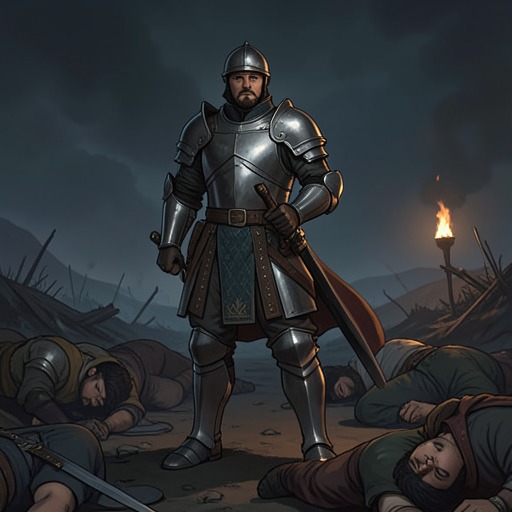
Dagon Mountain Resistance War
The Deer KingThe Toga Mountain resistance was a nearly two-year campaign in which Van and the Lone Antlers fought the advancing Zolian forces to influence the terms of the Gansa clans’ submission. Its central paradox was that the elders intended the fighting not as a path to independence but as a demonstration of military value: the clans hoped to secure a place within the empire without being driven from their homeland. The campaign’s tactics made that argument, and its fighters paid for it with their lives.
Conquest and the Question of Status
Aquafa had become a province of the Zol Empire, and its people were granted ordinary citizenship. The mountain clans of Toga, though they spoke Aquafa’s language and had defended its borders against incursions from the Kingdom of Mukonia, were not recognized as Aquafaese. Under the former King of Aquafa they had retained loose autonomy in return for allegiance; under Zolian rule, that earlier arrangement offered no guarantee of their status.
The conquest put the clans in a perilous position. Zol’s forces had gradually absorbed Aquafa and, after securing its central government, turned to the remaining task of subjugating Toga. The King of Aquafa sent messengers to offer the clans negotiations over their safety, but as a ruler whose kingdom had become a province, he could plead for their lives without deciding how the empire would classify them. Imperial policy called for lower-status populations to be relocated elsewhere in conquered territory. For the clans, losing the chance of ordinary citizenship therefore threatened not only their political standing but also their ability to remain at home.
A Strategy of Staged Resistance
After deliberating, the Gansa elders settled on a risky strategy: they would appear to resist Zol with a force prepared to fight to the death. The aim was to show that the clans could not be subdued cheaply and might instead make useful allies. Their knowledge of the mountains could help guard the empire’s new western frontier against Mukonia; if the Zolians valued that service, the Gansa hoped they might be allowed to stay.
The elders could contemplate this form of quasi-resistance because of the Lone Antlers, a band of warriors led by Van. Its members were men who had been deprived of ordinary lives, and its tradition traced its origins to the gods’ appearance as flying deer, or pyuika. Members were released from the usual rules binding the Gansa so long as they pledged to serve as the clan’s shield and give their lives when necessary. Outsiders fleeing calamity could also join as clansmen. The Toga frontier’s repeated epidemics, following incursions that brought both war and disease, had left many men bereaved; some of them joined the Lone Antlers, whose ranks grew to an unprecedented size.
When the elders offered Van and his men the mission, they accepted eagerly. Each carried sorrow and despair, and Van himself saw the assignment as a legitimate reason to make a final journey to his dead wife and son. His family had otherwise been lost to him, and he believed a rider who took his own life in despair would be denied the Land of Eternal Spring and condemned to walk the Road of Constant Day. The campaign thus carried a personal weight for Van, even as its political purpose belonged to the survival of the clans.
Guerrilla Campaign and Its Result
Van’s fighters used Toga’s steep mountains and forests to offset the advantage of the Zolian troops. They drew the enemy into difficult terrain, attacked suddenly from the trees or descended from sheer cliffs, and relied on the speed and agility of their pyuika to outmaneuver mounted soldiers. Their methods turned the landscape into a military advantage and made the riders a source of fear for the occupying force.
For almost two years, the campaign continued. The pressure eventually led Zolian commanders to consider retreat and offer the tribal elders favorable terms for a truce. While negotiations proceeded, the Lone Antlers maintained the appearance of fanatical opposition to the elders, fighting on as though they rejected compromise. Once their mission had served its purpose, the band fell. Their defeat was therefore also the deliberate endpoint of a strategy whose desired result depended on making their resistance seem unyielding.
Aftermath and Political Meaning
Van believed the elders and clansmen would not let the Lone Antlers’ deaths go to waste and would have secured whatever advantage they could from the campaign. But he did not know what had become of his homeland. His success had also earned him enemies among the Zolians, making a return dangerous: capture could bring further suffering to the people he wanted to protect. The campaign ended, then, without giving him either a secure homecoming or certainty about the settlement it had helped negotiate.
The conflict exposes the gap between being conquered and being incorporated on equal terms. Aquafa’s population received ordinary citizen status, while Toga’s clans—despite having fought for Aquafa’s borders—remained outside that category and faced the prospect of relocation. The Lone Antlers’ resistance answered this policy in the only currency the elders believed the empire might recognize: the military usefulness of the people it otherwise treated as expendable. Its bitter achievement was to turn a hopeless battle into leverage for the clans, while leaving the warriors themselves to bear the cost.